Keeping a bird notebook you will use
A few precise details written immediately can be more useful than a long species list reconstructed at night.
Make room for the ordinary visit
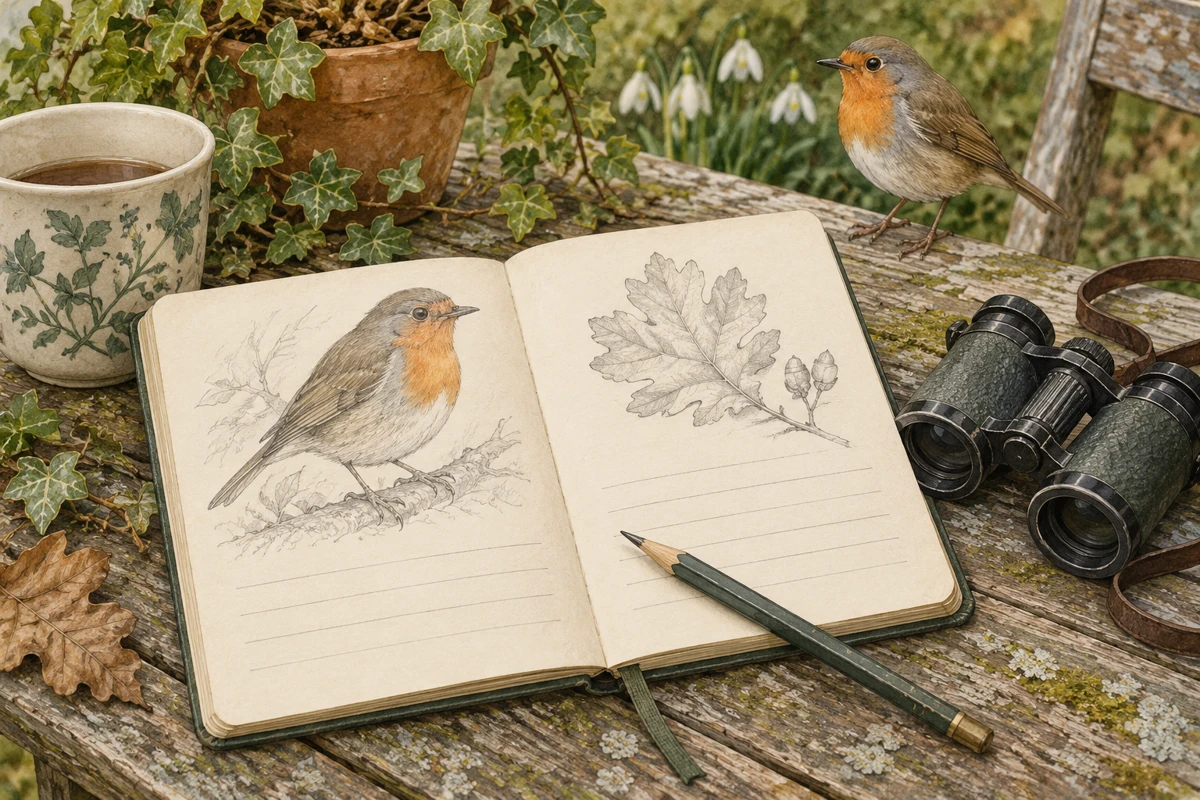
A bird notebook does not need to become a polished nature diary. Start with the date, place and the time you watched. Add a few words about weather and what you could see. Then record the birds and the details that made the encounter worth noting. A page with three clear observations is more useful than an ambitious layout you stop maintaining after a week.
Keep a pencil or pen with the notebook. If using a phone, choose a notes format that opens quickly and works without a signal. The best system is the one that lets you capture a detail before the bird leaves or memory supplies a tidier version.
Separate observation from interpretation
Consider the difference between robin fed young and robin carried food into ivy. The first may be true, but the second is what you actually saw unless a feeding event was visible. A small question mark or a separate sentence can preserve an interpretation without turning it into a fact.
For an uncertain identification, write features before consulting a guide: bill shape, wing markings, tail length, movement and sound. If you look up the likely species first, its description can begin to replace your memory. A rough sketch is useful because it forces you to decide where a marking appeared.
Include uncertainty in counts too. Four seen together and perhaps more hidden in hedge is better than an unexplained total of seven. Your future self will understand the limit of the observation.
Give repeated notes a common basis
If you want to compare weeks, note how long you watched and whether you used the same viewpoint. An hour on a quiet Sunday is not equivalent to a glance while making tea. Keep casual sightings alongside the regular watch, but label them so the two are not confused later.
Name garden areas consistently. The compost corner should not become back border in the next entry unless you explain that they are the same place. A small sketch map at the front of the notebook can solve this without complicated codes.
Share the right detail
If you submit records to BirdTrack or another scheme, follow its instructions rather than assuming every notebook convention transfers directly. A complete list has a specific meaning, and an automated identification alone should not be treated as confirmation.
Keep sensitive nesting locations out of public posts. A private note can be precise while a shared photograph uses a broader place name. You can preserve useful observations without directing other visitors to a vulnerable bird.